
Grilles
Description
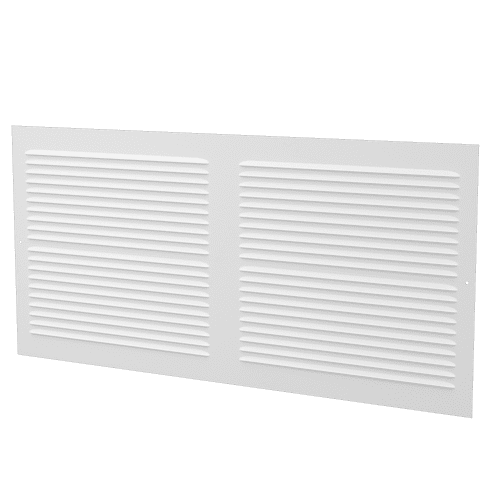
A vent grille (also called a diffuser or register) is a type of ventilation component commonly found in heating, ventilation, and air conditioning (HVAC) systems, as well as in kitchens, bathrooms, and other areas of buildings where air circulation is important. It is made with a simple louvered structure that is designed to cover an opening in a wall or ceiling through which air can flow in or out. The primary function of a vent grille is to allow air to flow in and out of a space while preventing the entry of foreign objects such as debris, insects, or animals. Vent grilles may also be equipped with filters to remove impurities from the air, or louvers to control the direction and volume of the air flow.
Frequently Asked Questions
Can Grilles be used for supply, return, or exhaust air?
Grilles—depending on their size, blade pattern, and connection—can be used for either supply, return, or exhaust openings.
How should airflow capacity be evaluated for Grilles?
The airflow for grilles is evaluated in CFM (cubic feet per minute) and is calculated by multiplying the face velocity of the air moving through the grille (measured in FPM, feet per minute) by the net free area of the grille (measured in square feet, or square inches divided by 144).
What does installing Grilles involve?
Using a level, align the grille with the wall opening where the supply/return/exhaust is connected. Afterward, screw the grille onto the wall, making sure not to leave any gaps where air can flow through.
What covers a supply or return opening and still lets air through?
Grilles cover HVAC supply, return, or exhaust openings while allowing air to pass between the duct system and the occupied space.